
Lead Battery Recycling

Disassembling Used Lead Batteries in Vietnam
Lead is easily melted down for reuse and therefore lead batteries are rarely discarded as waste. Recycling lead by melting down used batteries (also known as secondary smelting) is a profitable business throughout the world. Unfortunately, recycling lead from used batteries is known to result in high lead exposures that can cause severe health effects and contaminate the environment unless adequate equipment is used and procedures to minimize emissions are followed.
In many developing countries individuals working on the side of the road or in “backyard smelters” carry out lead battery recycling. Because of the primitive nature of these operations and their enormous number (estimated to be in the tens of thousands) the control of lead poisoning from the contamination of homes and the environment is a major challenge. In 2008 at least 18 children died and many more were poisoned from lead in Dakar, Senegal after exposure to contaminated dust and soil from the recycling of used lead batteries.
Large-scale recycling facilities are also known to be significant sources of lead exposure in many parts of the world. There are dozens of examples of informal and even large lead battery recycling plants that have been the source of lead poisoning among workers and local residents.
Growing Exports of Used Lead Batteries From the U.S.
OK International and our Mexican partners at Fronteras Comunes conducted an investigation on the large increase in used lead batteries being exported from the U.S. to Mexico for recycling in recent years. Given the considerable differences in environmental and occupational regulations between these countries, our findings raised significant concerns about the contribution of used lead batteries from the U.S. to lead poisoning south of the border.
See our report “Exporting Hazards: U.S. shipments of used lead batteries to Mexico take advantage of lax environmental and worker health regulations” in both English and Spanish. The report was also the subject of a front-page New York Times article. This led the Commission on Environmental Cooperation (CEC) to undertake an investigation under the NAFTA framework to assess the reasons for the increase in exports of used lead batteries to Mexico.
The CEC conducted a year-long investigation and released a report titled “Hazardous Trade?: An Examination of US-generated Spent Lead-acid Battery Exports and Secondary Lead Recycling in Mexico, the United States and Canada”, which provides an excellent summary of the key issues and outlines recommendations for all three governments. In addition to emphasizing the large increase in exports in recent years, and the discrepancies in environmental regulations across North America, the CEC report recommends that the governments of the United States, Canada, and Mexico:
-
Commit to equivalent environmental regulations to avoid the development of pollution havens;
-
Establish a regulatory framework in Mexico to close the gap in environmental performance with the U.S.; and
-
Ensure that accurate performance data including air emissions and employee blood lead levels be made available to the public.
In addition to Mexico, the U.S. exported smaller quantities of used lead batteries to 47 other countries in 2011 (including approximately 27 developing countries) many with weaker environmental standards and insufficient enforcement capacity. In addition, the U.S. is apparently allowing these exports to countries outside the OECD without obtaining consent from the receiving countries in violation of the Basel Convention. Our analysis shows that more lead is being exported from the U.S. in used batteries to Mexico, than in all the e-waste leaving the U.S.
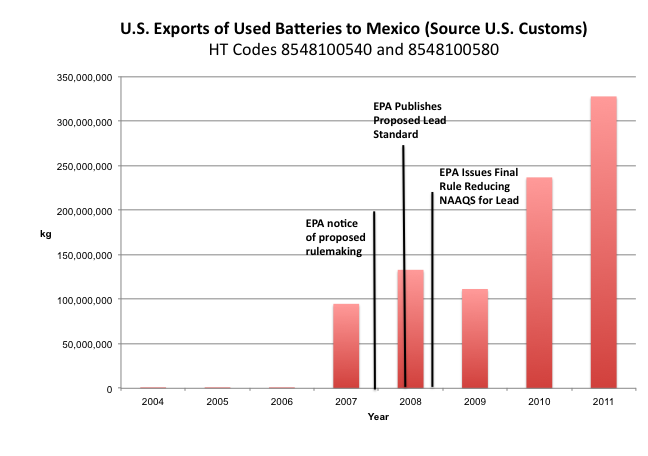
In tracking used lead battery exports from the U.S., we noted that exports to Mexico have been growing exponentially following the lowering of the lead emission standards in the U.S. under the Clean Air Act in 2008. The U.S. Customs data shows that the increase in used lead batteries exported to Mexico was twice as large in the four years starting in 2008 (209,204,651 kg) than in the previous four-year period (94,774,929 Kg) before the change in U.S. EPA regulatory standards (see the table below).
| Data Source | Increase 2004-2007 | Increase 2008-2011 |
|---|---|---|
| U.S. Customs | 94,774,929 | 209,204,651 |
This change can also be viewed graphically starting in 2007-2008 as the regulatory change was anticipated:

An Open Furnace is Used to Melt Batteries in Kolkata, India
Lead Battery Collection
National collection systems are needed to direct used lead batteries to environmentally sound recycling facilities. To be effective, the collection a system must provide financial incentives such as purchase discount or a deposit system. If designed correctly, such a program can gradually bring the informal sector to operate as collectors (and not recyclers) and contribute to its success. Laws establishing specific responsibilities on battery producers and mandatory fees (discount or deposits) are necessary to improve product stewardship.
China, India and some other countries already have general laws requiring lead battery manufacturers to take back used batteries for recycling. However, these are largely ineffective because they don’t provide financial incentives and do not impose penalties for noncompliance. For example, the Indian Battery Management and Handling Rules, require lead battery manufacturers to collect a minimum of 90% of the batteries sold through dealers. The law established an extensive reporting system to track the supply chain. In order to evaluate compliance with this law, OK International obtained individual company reports filed with the government. The data indicates that very few companies are complying with this law and even large battery producers are falling short of the mandatory provisions in this standard. See OK International’s report investigating India’s used battery collection.
Environmental Benefits of Improved Recycling
Recycling lead used in batteries improves the utilization of the metal, reduces greenhouse gas emissions, and saves energy. However, informal sector recycling carried out by dismantling batteries and melting down the material in open vessels or crude furnaces can easily result in 50 percent of the lead to be lost to the environment. The recovered lead from most of these processes is of very poor quality and unusable for making new high quality lead batteries without additional refinement.
Improving recycling practices will provide significant energy savings and result in less greenhouse gas emissions. Recovering lead from used batteries is much less energy intensive than producing primary lead from ore – using approximately 39% less energy than that needed to produce lead from mining and resulting in a 39% decrease in greenhouse gas emissions.